How to Clean a Pool Without a Vacuum: 7 Manual Methods (And 1 Effortless Alternative)
There’s nothing more frustrating than looking out at a dirty pool floor, especially when your vacuum is broken or you simply don’t own one. The thought of spending a fortune on new equipment or wrestling with tangled hoses can be daunting. If you're looking for practical ways on how to clean a pool without a vacuum before your guests arrive, you’ve come to the right place. We believe every Kiwi pool owner deserves a simple way to get that crystal-clear water.
As trusted pool care experts, we're here to help. This guide will walk you through seven effective manual techniques to clear away leaves,
dirt, and debris from the bottom of your pool. We’ll cover the pros and cons of each so you can find the right fit for your situation. Plus,
for those who dream of a truly hands-off solution, we’ll reveal the one effortless alternative that makes pool cleaning completely
hassle-free.
Key Takeaways
- Master several hands-on techniques using simple tools like a pool brush and leaf rake to remove leaves and larger debris from your pool floor.
- Discover how to use your pool's own filtration system and specific water treatments to help gather fine dirt, making it easier to remove.
- While you can learn how to clean a pool without a vacuum, it's important to understand the significant time and effort these manual methods demand.
- Explore the modern, automated alternative that delivers a crystal-clear, healthy pool without the hassle of manual labour.
Table of Contents
- The 'Big Three' Manual Methods for Debris Removal
- Leveraging Your Pool's Systems and Chemical Helpers
- The Reality Check: Is Manual Cleaning Worth Your Weekend?
- The Effortless Alternative: Cleaning Without Manual Labour
The 'Big Three' Manual Methods for Debris Removal
Before the age of effortless robotic cleaners, keeping a pool pristine meant rolling up your sleeves. If you're looking for how to clean a pool without a vacuum, these traditional, hands-on techniques are your starting point. They rely on basic tools that most Kiwi pool owners already have, like a good brush and net. These methods are best for tackling visible debris such as leaves, twigs, and sand that have settled on your pool floor. Be prepared, though: they require a bit of physical effort and patience to get the job done right.
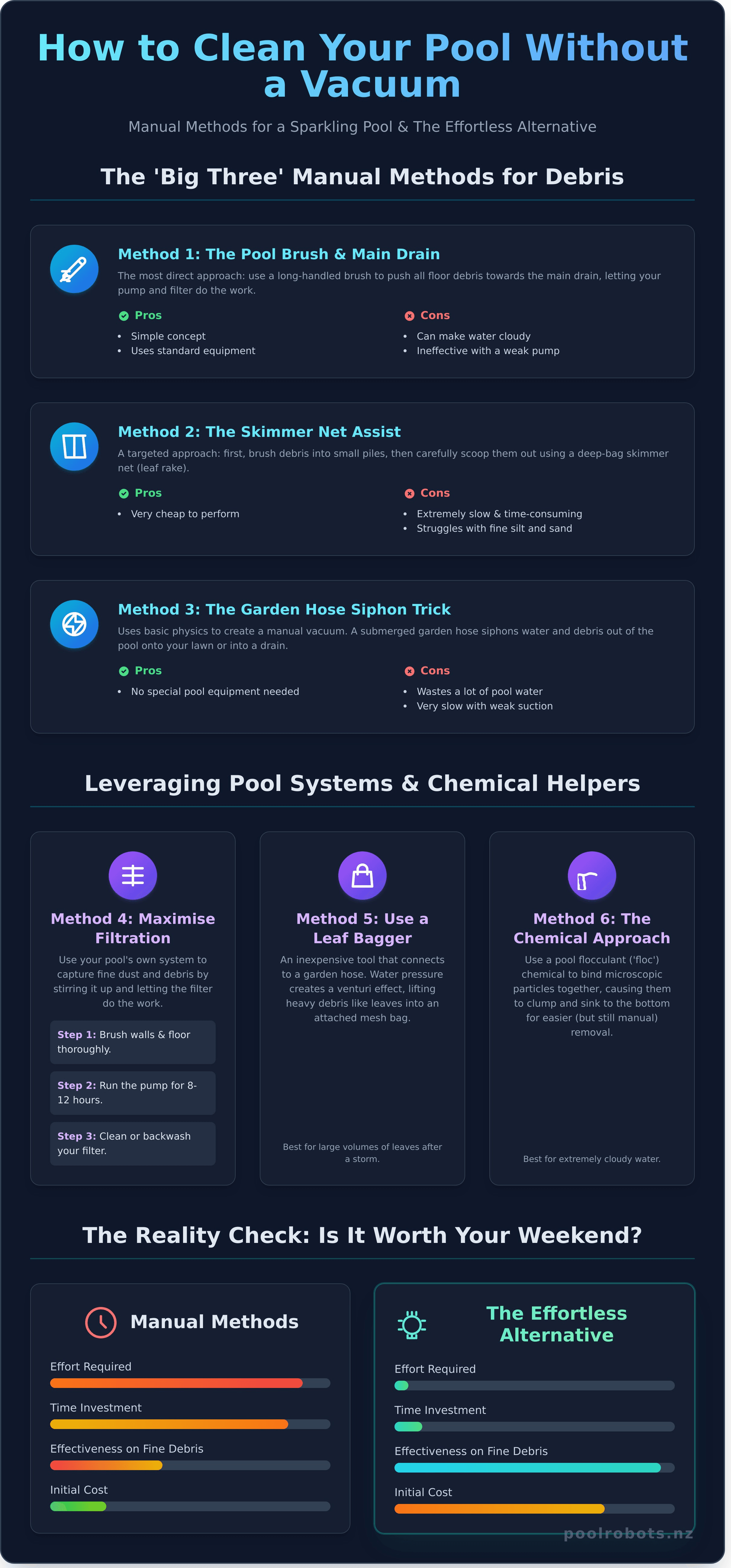
Method 1: The Pool Brush & Main Drain Technique
This is the most straightforward approach. Using a long-handled pool brush, you simply push all the debris on the pool floor towards the main drain at the deep end. Start at the shallow end and work your way down, using long, overlapping strokes to avoid missing spots. For this to be effective, you need a powerful pump and a clean, efficient filter to suck up the debris you've corralled. This method is a key part of regular maintenance, as it helps your filter do its job, which is just one component of many swimming pool sanitation methods needed for a healthy pool.
- Pros: A simple concept that requires only a standard pool brush.
- Cons: Can stir up fine dirt and silt, making the water cloudy. It's not very effective if your pool pump is weak.
Method 2: The Skimmer Net Assist
Think of this as a more targeted version of the brushing technique. First, use your pool brush to gently sweep debris into one or two manageable piles on the pool floor. Then, take a deep-bag skimmer net (often called a leaf rake) and carefully scoop the piles out of the pool. This is a slow, methodical process that requires a steady hand to avoid stirring everything back up. It’s a classic solution for how to clean a pool without a vacuum when you have larger clumps of leaves to remove.
- Pros: Very cheap, as it only requires a brush and a net.
- Cons: Extremely time-consuming and labour-intensive. It struggles to pick up fine silt, sand, and algae.
Method 3: The Garden Hose Siphon Trick
This clever method uses basic physics to create a manual vacuum. Submerge a standard garden hose completely in the pool to fill it with water. With both ends still underwater, place your thumb securely over one end. Lift that end out of the pool and lower it to a point below the water level (like onto your lawn or into a drain). Release your thumb, and gravity will create a siphon, sucking water and debris out through the hose. You can then slowly guide the other end around the pool floor.
- Pros: Requires no special pool equipment, just a garden hose.
- Cons: Wastes a significant amount of pool water, which you'll need to replace. The suction is weak, and it's a very slow process.
Leveraging Your Pool's Systems and Chemical Helpers
While manual tools are effective, the smartest way to clean your pool is to make your existing equipment do the heavy lifting. These methods focus on letting your pool's built-in systems and some clever chemical aids do the work for you. Think of these as 'set and wait' techniques that, when combined with a thorough brushing, help your pool clean itself. For any of these to be effective, you must start with a clean and fully functional filter-it’s the heart of your pool's cleaning power.
Method 4: Maximising Your Pool's Filtration System
Your pool's pump and filter are designed to remove suspended particles from the water. You can use this to your advantage to capture fine dust and debris. This is a core part of how to clean a pool without a vacuum. The process is simple:
- Brush Thoroughly: Start by brushing the walls, steps, and floor of your pool. Work from the shallow end towards the deep end, pushing all the loosened debris into the water.
- Run the Pump: Immediately after brushing, run your pool pump for an extended period, typically between 8 to 12 hours. This will circulate the water and allow the filter to trap the particles you've just stirred up.
- Clean the Filter: Once the water looks crystal clear again, your filter will have collected all that grime. Be sure to backwash your sand or DE filter, or clean out your cartridge filter, to restore its efficiency.
Method 5: Using a Leaf Bagger (Venturi Pump)
When you're faced with a large volume of leaves after a storm, a simple scoop can feel like an endless task. A leaf bagger is a fantastic, low-cost solution. This device attaches to a standard tele-pole and connects to your garden hose. The water pressure from the hose creates a venturi effect, generating suction that lifts leaves and larger debris off the pool floor and into an attached mesh bag. It's far more efficient than scooping, but it still requires you to manually guide it across the pool floor.
Method 6: The Chemical Approach with Flocculant
For extremely cloudy water caused by microscopic particles, a pool flocculant (or 'floc') can be a powerful ally. Flocculant is a chemical that causes tiny, suspended particles in the water to bind together. These newly formed clumps become heavy and sink to the bottom of the pool, leaving the rest of the water remarkably clear. Proper chemical handling is crucial for a healthy and safe swimming environment, as this detailed pool water care guide explains. However, it's important to understand this is a two-step process. The flocculant only sinks the problem; it doesn't remove it. This method almost always requires a vacuum to carefully suck up the settled layer of debris on the 'waste' setting. Attempting to brush it will simply suspend the particles back into the water, undoing all your hard work.
The Reality Check: Is Manual Cleaning Worth Your Weekend?
While the methods we've covered are effective in a pinch, it's time for an honest conversation. Knowing how to clean a pool without a vacuum is one thing, but making it your weekly routine is another. The real question isn't just about getting debris out of the water; it's about the true cost to your time, energy, and the overall health of your pool.
The Time Commitment Factor
Manually brushing, scooping, and settling debris can easily consume 1-2 hours of your precious weekend. Compare that to the five minutes it takes to place a robotic cleaner in the water and press a button. What is an hour of your free time worth? Is it more time with the kids, firing up the BBQ, or simply relaxing? For most Kiwi pool owners, the answer is clear.
Want to reclaim your weekends? See how an automatic cleaner can help.
The Physical Effort Involved
Let's be realistic: wrestling with long poles, heavy leaf rakes, and unwieldy hoses under the hot New Zealand sun is hard work. It can be physically straining, especially on your back and shoulders. A swimming pool is meant to be a source of relaxation, not another chore on your to-do list. An automated solution removes the labour, turning pool maintenance into a "set and forget" task.
The Effectiveness Gap
Even with your best efforts, manual methods often struggle with the things you can't see. Fine dust, silt, and stubborn algae spores can be missed, leaving your pool looking 'clean-ish' but never truly sparkling or healthy. This inconsistent cleaning allows small problems to grow. A robotic cleaner, by contrast, actively scrubs surfaces and filters out microscopic particles, ensuring a consistently crystal-clear and hygienic swim every time.
Ultimately, while manual techniques are useful backup skills, they don't offer a sustainable, long-term solution for maintaining a pristine pool. The modern approach to pool care prioritises efficiency and results, giving you a healthier pool with none of the hassle.
The Effortless Alternative: Cleaning Without Manual Labour
While the methods above can work in a pinch, they still require your time and physical effort. Let’s be honest: when you search for how to clean a pool without a vacuum, what you’re really asking is how to get a sparkling clean pool without the back-breaking work. You want to reclaim your weekends, not spend them wrestling with hoses, nets, and brushes. The true solution isn’t just a different tool; it’s a modern, intelligent system that does the work for you.
Enter the Robotic Pool Cleaner
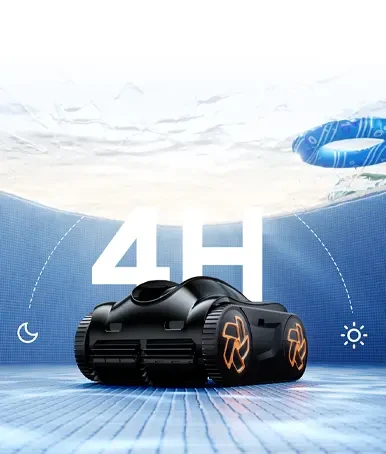
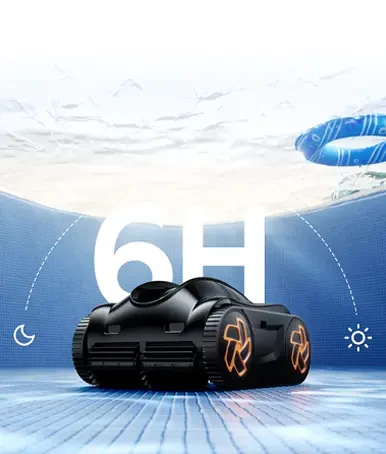
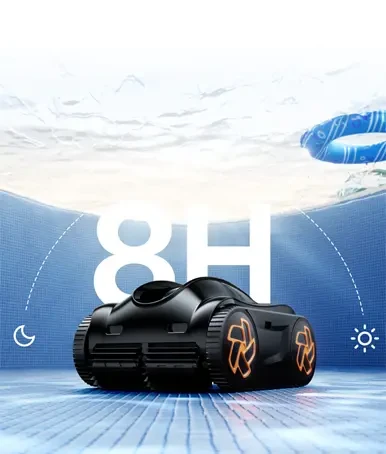
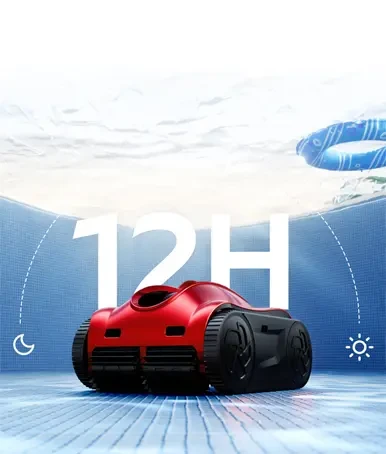
A robotic pool cleaner is a completely self-contained, autonomous unit designed to make your life easier. Think of it as a smart, underwater vacuum that requires zero supervision. Unlike traditional suction or pressure cleaners, it doesn't need any hoses or connections to your pool's pump or filtration system. The process is incredibly simple: you just plug it into a standard power outlet, drop it into the water, and press start. It’s the set-and-forget answer to pool maintenance.
How Robots Make Manual Methods Obsolete
A robotic cleaner delivers a level of clean that manual methods simply can't match. They are engineered for efficiency and performance, systematically taking over every tedious aspect of pool care. Here’s how they outperform old-school techniques:
- They Actively Scrub Surfaces: High-speed PVA brushes scrub the floor, walls, and even the tricky waterline, dislodging stubborn algae and grime that a simple net or brush would miss.
- They Capture Ultra-Fine Debris: Their powerful internal motors and fine-micron filter bags trap everything from large leaves to fine sand and silt, leaving your water crystal clear.
- They Offer Complete Coverage: Using smart navigation technology, they map out and clean your entire pool, ensuring no spot is missed, from the deep end to the shallow steps.
- They Save Water and Energy: Because they run independently of your pool pump, you reduce the load on your main filtration system. This means less backwashing, saving thousands of litres of water and chemicals each year.
The Best Investment for a Hassle-Free Pool
Viewing a robotic cleaner as an expense is missing the point; it’s an investment in your time, your convenience, and the overall health of your pool. The long-term savings on water, chemicals, and energy often make it one of the smartest upgrades a Kiwi pool owner can make. It’s the ultimate, definitive answer to the question of how to clean a pool without a vacuum. Instead of labouring under the sun, you can spend your time actually enjoying your pristine pool with family and friends. Ready to get your weekends back? Find the perfect iGarden robot for your pool today.
Reclaim Your Weekend: The Smart Way to a Sparkling Pool
As we've seen, knowing how to clean a pool without a vacuum using manual tools is certainly possible. These methods, from skimming to brushing, can work in a pinch. However, they demand significant time and physical effort, often taking the relaxation right out of pool ownership. The key takeaway is that for a truly hassle-free, crystal-clear pool, automation is the most effective and reliable answer.
If you're ready to trade hours of labour for an effortlessly clean pool, we're here to help. As New Zealand's robotic pool cleaner specialists and a trusted dealer of iGarden cordless robots, we make finding the perfect automated solution easy. We even offer free, no-obligation demonstrations to help you choose with complete confidence for your Kiwi backyard.
Stop working on your pool and start enjoying it. Talk to a New Zealand pool robot expert today!