Quiet Pool Pump Solutions NZ: Your Guide to a Silent Backyard in 2026
What if the loudest thing in your backyard this summer was the sound of a cold drink pouring, rather than the mechanical roar of your filtration system? Most Kiwi pool owners accept that a humming, vibrating pump is just part of the deal. It's frustrating when you're trying to relax or when a neighbor mentions the noise during late-night hours. You're likely tired of seeing those NZ$120 monthly power spikes caused by an outdated, single-speed motor that only knows how to run at full throttle. Finding the right quiet pool pump solutions nz can feel overwhelming with all the technical jargon, but it doesn't have to be.
We make upgrading your pool equipment easy by focusing on what actually matters: your peace and your pocket. We promise to show you exactly how to eliminate that raucous vibration and restore your backyard sanctuary using New Zealand’s leading silence-focused technologies. You'll discover how the latest 2026 inverter models can lower your monthly power bills by up to 70% while running at a whisper-quiet 35 decibels. This guide provides expert advice on equipment for Kiwi pools to help you choose a pump that's as efficient as it is silent.
Key Takeaways
- Learn to identify the specific causes of your pool's noise, from mechanical whines to hydraulic roars, to target the right fix for your Kiwi backyard.
- Understand why switching to variable-speed technology can slash noise levels significantly more than just cutting RPMs, saving you money and sanity.
- Discover how the iSaver VFD provides one of the most effective quiet pool pump solutions nz homeowners can use to silence existing equipment without a full replacement.
- Follow five practical, expert-backed steps to create a peaceful outdoor environment using simple vibration-dampening techniques and smart tech upgrades.
- Find out how partnering with a local specialist makes achieving a hassle-free, silent pool easy while ensuring your equipment runs at peak efficiency.
Why is My Pool Pump So Loud? Understanding the NZ Noise Problem
Is your backyard sanctuary being ruined by a constant, soul-crushing drone? You aren't alone. Many New Zealand pool owners find that their equipment starts off whisper-quiet but becomes a neighborhood nuisance within 3 to 5 years. Finding effective quiet pool pump solutions nz starts with identifying exactly what is making that racket. Noise usually falls into two distinct categories: mechanical whine and hydraulic roar.
A mechanical whine comes from the motor itself. This is often a sign of aging internal components or friction. A hydraulic roar is different. It's the sound of water turbulence and pressure. If your pump sounds like a jet engine, it's likely a mechanical bearing issue. If it sounds like rushing rapids or heavy vibration, it's usually a plumbing or flow problem. In the clear, still air of a Kiwi evening, these sounds carry much further than you might expect.
Our harsh Southern Hemisphere sun is a major contributor to pump degradation. In regions like Northland or the Bay of Plenty, summer UV levels frequently peak above 11 on the index. This intense radiation creates extreme heat stress on the pump housing. Over time, plastic components become brittle and rubber seals dry out. This leads to micro-vibrations that amplify noise across your pool decking or through the walls of your home. It's a uniquely New Zealand problem that requires robust, UV-resistant equipment.
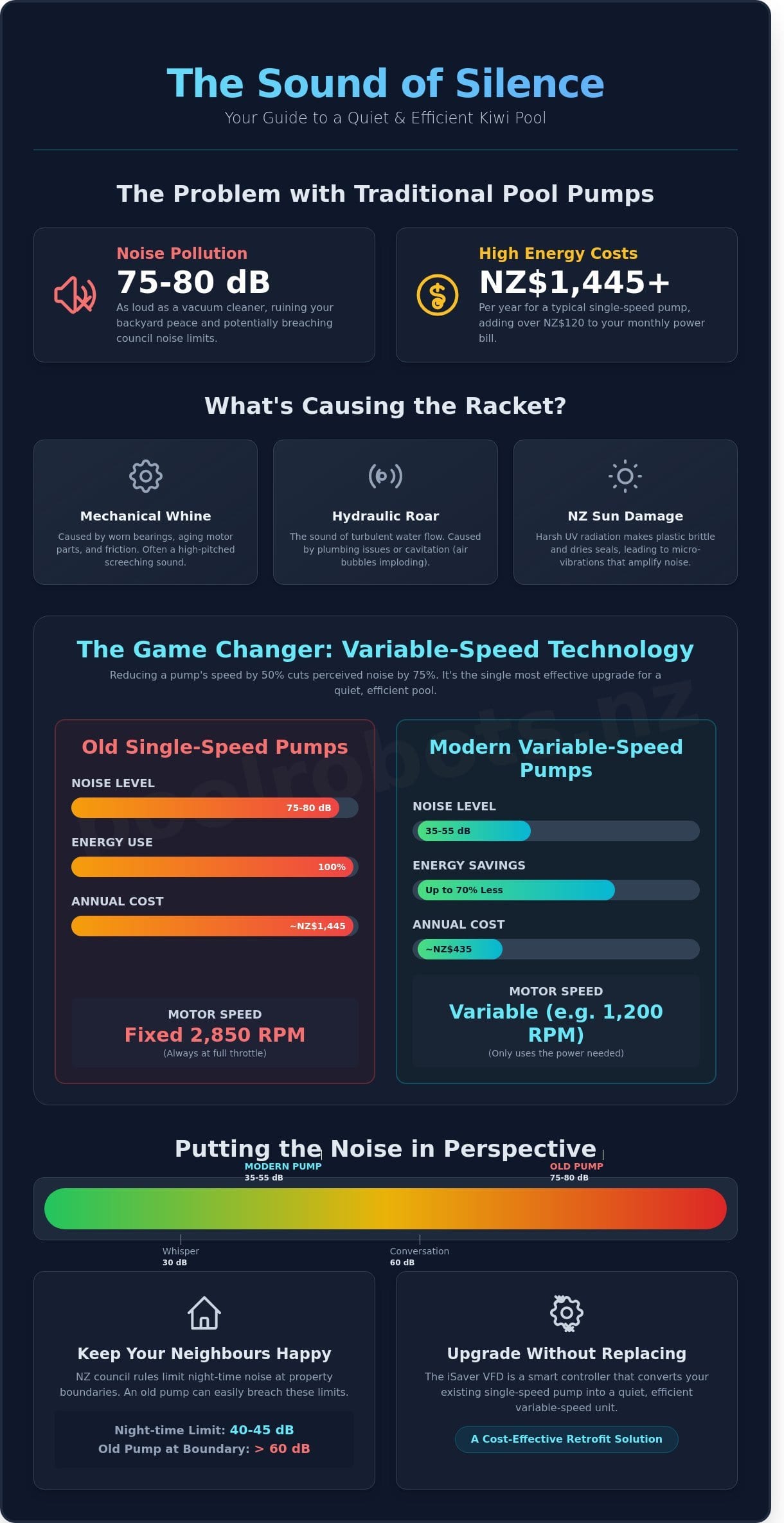
What does 'quiet' actually mean in technical terms? A standard, older single-speed pump operates at roughly 75 to 80 decibels (dB). For context, that's as loud as a vacuum cleaner or a garbage disposal unit. A modern, high-efficiency quiet pump operates between 45 and 55 dB. This is a massive 25 dB reduction. Because the decibel scale is logarithmic, a 10 dB drop actually represents a 50 percent reduction in perceived noise. Moving to a 50 dB model is the difference between a loud conversation and a soft whisper.
The Science of Pump Noise: Bearings, Fans, and Cavitation
Worn bearings are the most common culprit for high-pitched screeching. These small metal balls lose their lubrication and grind against the metal housing. Understanding How a Centrifugal Pump Works helps explain why this happens. The internal impeller must spin at high speeds, often 2,850 RPM, to move water effectively. If air enters the system through a leak, you get cavitation. This creates tiny vacuum bubbles that implode with enough force to pit metal. It sounds exactly like you're pumping gravel through the pipes. Traditional pumps also rely on loud external fans for cooling, which adds a constant, aggressive whirring sound to your backyard.
NZ Council Regulations on Pool Equipment Noise
Noise isn't just an annoyance; it's a compliance issue. The Auckland Unitary Plan and the Christchurch District Plan generally limit residential noise to 40 or 45 dB at the property boundary during night hours, typically from 10 pm to 7 am. While running your pump at night is a smart way to lower your power bills, it's the most common cause of friction with neighbors. A noisy, aging pump can easily reach 60 dB at the boundary, which is a direct breach of local bylaws. Protecting the 'backyard peace' is a core part of the Kiwi lifestyle. Investing in quiet pool pump solutions nz ensures you stay on friendly terms with the people next door while keeping your water crystal clear and healthy.
Single-Speed vs. Variable Speed: The Decibel Gap
Traditional pool pumps operate like a car engine stuck in one high gear. They run at a fixed rate, usually around 2,850 RPM, regardless of whether you are backwashing the filter or simply circulating water. This constant high-speed operation creates a persistent, low-frequency drone that can easily penetrate NZ timber boundary fences and disturb your neighbours. When searching for quiet pool pump solutions nz, the shift from fixed to variable speed is the most significant upgrade you can make.
The physics of sound in pool equipment is surprising. If you reduce a pump motor's speed by 50%, you don't just halve the noise. You actually reduce the sound pressure by roughly 15 decibels. This is because noise levels drop exponentially as the RPM decreases. A variable speed pump running at 1,200 RPM is often 75% quieter than a standard single-speed unit. It's the difference between a loud vacuum cleaner and a soft breeze through the trees.
The financial side is just as compelling as the silence. With New Zealand electricity prices averaging around $0.33 per kWh in 2024, running a 1.5kW single-speed pump for 8 hours a day costs roughly NZ$1,445 per year. A variable speed pump running at a lower, quieter flow rate can perform the same filtration task using as little as 0.2kW. By the time 2026 efficiency standards are fully adopted, these energy-efficient pool pumps will be the expected norm for every sustainable Kiwi home.
The 'Whisper' Factor: How Variable Speed Works
The 'hum' of a pump comes from two places: the motor vibration and the turbulence of water moving through the pipes. At lower RPMs, both factors diminish. Lower speeds also lead to better water clarity. When water moves slowly through your filter media, it has more contact time to trap fine debris that high-pressure systems often push straight back into the pool. Variable speed technology is the gold standard for modern NZ pools.
Water-Cooled vs. Air-Cooled Motors
Most traditional pumps are air-cooled, meaning they use a spinning internal fan to stay cool. This fan is frequently the loudest component of the entire system. Water-cooled motors eliminate this fan entirely. Instead, they use the pool water itself to pull heat away from the motor. This design creates a near-silent operation because there is no air turbulence or fan whistle.
In the New Zealand climate, water-cooled systems offer a distinct advantage for longevity. Our high UV levels, which often peak at index 12 or higher in summer, can cause the plastic cooling vents on air-cooled pumps to become brittle and crack over a 5 to 7 year period. Water-cooled units are typically fully encased, protecting the internal components from salt spray and moisture. While they require a slightly higher initial investment, the reduction in noise and the increased resistance to our coastal conditions make them a top choice. If you want to see how these pumps integrate with other automated systems, you can talk to a pool robot expert to find a compatible setup for your backyard.
The iSaver VFD: Making Your Existing Pump Quiet Without Replacement
You don't always need to rip out your old equipment to enjoy a peaceful backyard. Many Kiwi homeowners find themselves stuck with a perfectly functional but incredibly noisy single-speed pump. Instead of spending thousands on a full system overhaul, the iSaver Variable Frequency Drive (VFD) offers one of the most effective quiet pool pump solutions nz residents can install today. This clever device acts as a brain for your existing motor, allowing you to regulate its speed rather than running it at 100% capacity all day long.
The iSaver VFD works by sitting between your power point and your pump. It converts your standard single-speed motor into a variable-speed powerhouse. By reducing the motor speed, you don't just save on electricity; you drastically lower the vibration and "whine" associated with pool filtration. Running a pump at 80% speed instead of 100% can reduce noise levels by up to 25 decibels. This turns a mechanical roar into a gentle hum that won't disturb your neighbours or your afternoon coffee on the deck.
Retrofitting vs. Replacing: Which is Right for You?
Deciding whether to retrofit depends on the current health of your hardware. If your pump is less than five years old and the bearings are still silent, an iSaver is a brilliant investment. However, if your motor is already screaming or leaking from the housing, it's better to invest in a dedicated variable speed unit. The ROI calculation for the iSaver is impressive for the average New Zealand household. With NZ power prices averaging around $0.30 per kWh, a standard 1.5HP pump costs roughly $900 to run annually. The iSaver can slash this by 80%, meaning the unit often pays for itself in less than 18 months. Most single-speed pumps up to 2.2kW are compatible, making it a universal fix for older setups.
Smart Control at Your Fingertips
The beauty of the iSaver lies in its "plug and play" design. While we always recommend a local sparky for permanent outdoor wiring, the interface is designed for the everyday Kiwi DIYer to manage. You can set up to four different timers and 35 different speeds. This allows you to program a high-speed cycle for 2 hours during the day for cleaning, then drop down to a low-speed "Silent Mode" for 10 hours of filtration.
The user experience is immediate. Once you hit the "save" button on a lower RPM setting, you'll notice a physical hush fall over your pool area. It's a satisfying moment for any pool owner. You're no longer restricted by a "one size fits all" approach to filtration. You get the power when you need it for vacuuming and the silence you want when you're entertaining. It's a professional-grade upgrade that brings 2026 technology to your existing pool shed without the waste of a full replacement.
- Noise Reduction: Up to 25dB lower than standard operation.
- Energy Savings: Cuts power consumption by up to 80% on low settings.
- Lifespan Extension: Running motors at lower speeds reduces wear on seals and bearings.
- Flexibility: 35 adjustable speed settings to suit your specific pool volume.
5 Practical Steps to a Silent Pool Backyard
Achieving a peaceful outdoor space requires more than just buying a high-end motor. It involves a systematic approach to how your equipment interacts with its environment. If you're searching for quiet pool pump solutions nz, these five steps will help you transform a noisy equipment pad into a whisper-quiet system.
Step 1: Upgrade to a variable-speed motor. Single-speed pumps are the primary cause of backyard noise because they always run at 3,450 RPM. By switching to a variable-speed model, you can drop the speed to 1,500 RPM for daily filtration. This simple change reduces noise levels by up to 75 percent. Because sound intensity follows an exponential curve, a small drop in RPM results in a massive reduction in decibels.
Step 2: Install vibration-dampening rubber pads. Often, the "hum" you hear isn't the motor itself, but the vibration transferring into the concrete pad. Placing a 20mm high-density rubber mat under the pump base acts as a shock absorber. This prevents the concrete from acting like a speaker for the motor's internal movements.
Step 3: Clear baskets to prevent cavitation. When your pump or skimmer baskets are 50 percent full, the pump has to work harder to pull water. This creates cavitation, a process where tiny vacuum bubbles form and collapse against the impeller. It sounds like someone threw a handful of marbles into your pump. Keeping these baskets clear ensures smooth, silent water flow.
Step 4: Fix suction line air leaks. If you see bubbles dancing under the clear pump lid, you have an air leak. These "micro-bubbles" make the pump sound erratic and strained. Most air leaks occur at the pump lid O-ring or the intake unions. Replacing a dry, cracked O-ring for roughly NZ$12 to NZ$18 can instantly quiet a struggling motor.
Step 5: Use a ventilated acoustic enclosure. A dedicated "pump shed" can drop noise by another 10 to 15 decibels. However, heat is the enemy of pool electronics. Ensure any box you build has at least 30cm of clearance on all sides and includes offset vents. These vents allow heat to escape while forcing sound waves to bounce off internal baffles before exiting.
Maintenance Hacks for Noise Reduction
A noisy pump often signals a simple maintenance oversight. If you hear a high-pitched whistling, check the O-rings first. A dry seal allows air to enter the system, which creates turbulence and noise. Applying a silicone-based lubricant twice a year keeps these seals airtight. Additionally, keeping your filter clean is vital. A dirty sand or cartridge filter increases backpressure, forcing the motor to run hotter and louder. By maintaining a clean system, your quiet pool pump solutions nz will stay effective for years to come.
Vibration Dampening and Acoustic Barriers
Material choice matters in the New Zealand climate. Avoid cheap foam pads, as they compress and lose effectiveness within 12 months. Instead, use recycled rubber mats designed for heavy machinery. For those building sound barriers, landscaping is a brilliant, natural alternative. Planting native NZ species like Griselinia littoralis (Kapuka) or Pittosporum tenuifolium (Kohuhu) provides a dense, evergreen screen. These plants have thick leaves that effectively muffle mid-to-high frequency motor whirring, blending your equipment into the garden landscape.
Ready to make your pool maintenance completely effortless? Talk to a pool robot expert at Pool Robots NZ today to see how the latest technology can simplify your life.
Why Pool Robots NZ is Your Partner in Silence
A peaceful backyard is the heart of the Kiwi summer. When your pool pump sounds like a jet engine, it disrupts your morning coffee and bothers the neighbours. At Pool Robots NZ, we don't just sell equipment; we provide "Hassle-Free" pool ownership. We've spent years identifying the most reliable quiet pool pump solutions nz homeowners can trust to restore the serenity of their outdoor spaces. Our goal is to make your pool maintenance effortless, so you spend more time swimming and less time troubleshooting hardware.
We take a different approach than big-box retailers. We're a specialized, focused business that values long-term relationships over quick sales. If your current pump is loud, we don't automatically tell you to scrap it. Our expert advice approach means we look at your specific setup first. We help you fix and optimize what you have whenever possible. Whether it's a simple vibration fix or a smart technology upgrade, we guide you toward the quietest, most cost-effective result for your New Zealand home.
Specialized Local Expertise
Being New Zealand's specialists means we understand the unique challenges of our climate and local power costs. We know that NZ electricity prices have risen by roughly 3% annually over the last decade, making energy efficiency just as vital as noise reduction. Our team is passionate about finding solutions that work for local plumbing standards and weather conditions. We're here to talk to you directly. You can reach us at our Auckland base for genuine, human advice on how to silence your system. We're not just an e-commerce site; we're your local partners in pool care.
- Personalized Consultations: We analyze your pool's volume and current flow rate to recommend the right settings.
- Energy-Focused Solutions: We prioritize products that slash your carbon footprint and your monthly bill.
- Authorized Support: As authorized dealers, we handle all warranty claims locally, giving you total peace of mind.
The iSaver Advantage
The iSaver VFD is the cornerstone of our quiet pool pump solutions nz range. It's a revolutionary frequency drive that transforms your existing single-speed pump into a high-performance variable speed unit. By allowing your pump to run at lower speeds for longer periods, the iSaver reduces motor noise by up to 25% and can cut energy consumption by a massive 80%. For a standard 1.5HP pump, this can represent a saving of over NZ$700 per year on your power bill. It's a smart, sustainable way to upgrade without the waste of replacing a perfectly good pump motor.
Every iSaver VFD we supply comes with a comprehensive 2-year warranty and full technical support from our NZ-based team. We've seen these units perform exceptionally well in coastal environments and high-use family pools across the country. Installation is straightforward, but our experts are always a phone call away if you need guidance on the optimal timer settings for your specific pool size. We make the technical side easy so you can enjoy the results.
Don't let a noisy motor ruin another weekend. We're ready to help you find the perfect balance of performance and silence. Shop the iSaver VFD and start enjoying a quiet pool today or contact us for a free consultation. Let's make your pool maintenance truly hassle-free.
Take Control of Your Backyard Noise Today
You don't have to tolerate a roaring pool pump that disrupts your peace and disturbs the neighbors. Switching from a standard single-speed motor to a variable speed setup can reduce noise levels by up to 80%. If you aren't ready for a full replacement, the iSaver VFD is a game-changer. It allows you to control your existing motor speed, potentially saving you over NZ$700 in annual energy costs while creating a whisper-quiet environment. Finding the right quiet pool pump solutions nz is the fastest way to turn your backyard back into a sanctuary.
At Pool Robots NZ, we are New Zealand's robotic pool specialists and an authorized iSaver VFD dealer. Our team offers expert local support to ensure your equipment runs perfectly for the 2026 season and beyond. We take the guesswork out of pool maintenance so you can focus on relaxing. Whether you need technical advice or a simple plug-and-play solution, we're here to help you get the best results for your home.
Transform your pool into a silent oasis with the iSaver VFD
Your perfect, peaceful backyard is just one simple upgrade away.