Troubleshooting Robotic Pool Cleaner Problems: The Ultimate Kiwi Guide (2026)
Last Saturday, Mike in Tauranga stood by his pool with the BBQ prepped for ten guests, only to find his robotic cleaner upside down and completely motionless. Instead of a crystal clear swim, he was staring at a NZ$2,400 investment that simply refused to budge. If you've ever felt that same sinking feeling, you aren't alone. Mastering troubleshooting robotic pool cleaner problems is the difference between a wasted weekend and a hassle-free summer.
We agree that there's nothing more frustrating than a cloudy pool when the mercury hits 28 degrees, especially when you're worried about a massive repair bill. It's easy to feel overwhelmed by flashing red lights or confusing cordless battery indicators. Our expert guide will save you time and money by showing you how to diagnose the most common issues right from your backyard. We'll walk you through simple DIY fixes, explain the secrets of preventative maintenance, and help you decide exactly when a professional repair is worth the investment.
Key Takeaways
- Learn our expert "First Aid" checklist to quickly clear physical obstructions and power issues, ensuring your pool stays crystal clear without unnecessary service costs.
- Master troubleshooting robotic pool cleaner problems by identifying whether a short run time is caused by mechanical drag or the way Lithium-ion batteries behave in the New Zealand climate.
- Discover the simple fixes for navigation faults, including how to rescue your robot from the "Circle of Death" and why your water chemistry affects wall-climbing efficiency.
- Use our professional "50% Rule" to decide if a repair is a smart investment or if upgrading to a 2026 model will save you more NZ$ and effort over time.
- Gain the confidence to handle your own maintenance with tips from New Zealand’s robotic pool cleaner specialists, designed to keep your machine running effortlessly all season long.
Table of Contents
- Essential First Steps: The Robotic Pool Cleaner "First Aid" Checklist
- Cordless Technology: Troubleshooting Battery and Charging Faults
- Movement and Navigation: Why Your Robot is Stuck or Moving in Circles
- Cleaning Efficiency: Solving Poor Suction and Wall Climbing Issues
- Repair or Replace? Making the Most Cost-Effective Choice for Your Pool
Essential First Steps: The Robotic Pool Cleaner "First Aid" Checklist
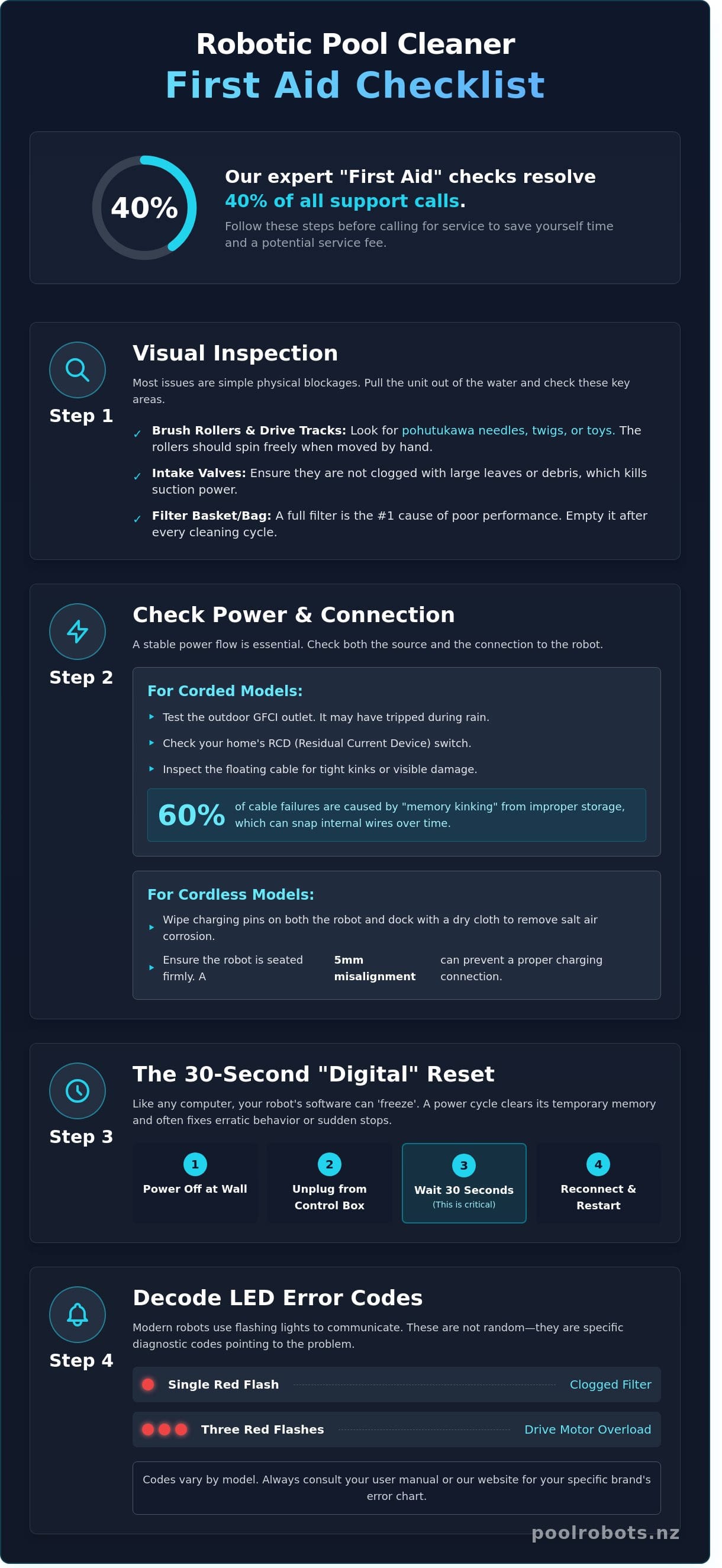
Finding your pool cleaner sitting motionless at the bottom of the deep end can be frustrating. Before you assume the motor has failed or consider a costly replacement, you should follow a basic diagnostic routine. Most issues stem from simple physical blocks or minor power interruptions. At Pool Robots NZ, we've found that 40% of support calls are resolved by these initial checks alone. When you begin troubleshooting robotic pool cleaner problems, the first step is always to look for the obvious.
Start with a thorough visual inspection. Pull the unit out of the water and flip it over on a soft surface. Check the brush rollers and drive tracks for obstructions. In New Zealand, it is common for pohutukawa needles, small twigs, or even stray pool toys to jam the mechanism. If the rollers do not spin freely when you move them by hand, the motor may be cutting out to prevent overheating. Clear any debris and ensure the intake valves are not clogged with large leaves.
Checking the Basics: Power and Connection
Your robot needs a stable flow of electricity to function. If you have a corded model, test the outdoor power point or GFCI outlet with another device, like a power tool or a lamp. It's common for outdoor breakers to trip during heavy Kiwi rainstorms. For cordless models, ensure the charging dock is connected properly. Use a dry, soft cloth to wipe the charging pins. In coastal regions like Napier or Whangarei, salt air can cause a thin layer of corrosion on these pins, which prevents a solid electrical connection. Cleaning them often restores charging functionality immediately.
- Inspect the floating cable: Look for "memory kinking" where the cord has looped over itself. Over 60% of cable failures happen because internal copper wires snap from being stored too tightly.
- Check the RCD: Ensure your Residual Current Device hasn't tripped. This is a safety feature standard in NZ homes that can be sensitive to moisture.
- Verify the dock: Ensure the robot is seated firmly. A misalignment of even 5mm can stop a cordless unit from charging.
The 30-Second Reset Procedure
Modern pool robots are essentially submerged computers. They use complex sensors and logic boards to map your pool. Sometimes, these systems "freeze" just like a laptop or smartphone. This is where troubleshooting robotic pool cleaner problems becomes a matter of digital maintenance. Turning the unit off and on again works because it forces the internal capacitors to discharge and clears the temporary memory cache. This often fixes erratic navigation or a robot that starts but stops after 2 minutes.
To perform a standard power cycle, follow these steps:
- Turn off the power supply at the wall.
- Unplug the cable from the control box or remove the robot from the water.
- Wait for exactly 30 seconds. This duration is vital to ensure all residual power leaves the circuit board.
- Plug everything back in and restart a new cleaning cycle.
A hard factory reset is a different process. This usually involves holding the main power button for 15 seconds while the unit is plugged in. You should only do this if a simple power cycle fails, as it may erase your programmed cleaning schedules. If your robot has a dedicated mobile app, check for firmware updates. A 5-minute software update can sometimes fix bugs that cause the robot to ignore certain corners of your pool.
Consulting the LED Error Codes
Most premium robots manufactured after 2022 include an LED diagnostic system. These flashing lights are not random; they are a specific language. For example, a single red flash on many popular models indicates a clogged filter, while three flashes often point to a drive motor overload. Keep your manual handy or visit our website to find the specific code chart for your brand. Identifying these codes early can save you from shipping your unit to a service centre when the fix is as simple as emptying the filter basket.
Cordless Technology: Troubleshooting Battery and Charging Faults
Cordless robotic cleaners offer incredible convenience for Kiwi pool owners, but they rely heavily on sensitive Lithium-ion technology. New Zealand's diverse climate plays a significant role in how these batteries perform. If you are in Central Otago, winter temperatures frequently drop below 5°C, while Northland summers can see ambient temperatures exceed 30°C. Lithium-ion batteries are chemically sensitive; charging them in sub-zero temperatures can cause permanent internal damage known as lithium plating. This often results in a battery that won't hold a charge for more than a few minutes. When troubleshooting robotic pool cleaner problems, always consider your local environment first.
A common frustration is the "Short Run Time" issue. Before assuming the battery is faulty, check for mechanical drag. A single stone or a clump of hair caught in the brush bearings can increase the motor's power draw by up to 30%. This extra strain drains the battery much faster than a standard cycle. If your robot usually runs for 90 minutes but now stops at the 40-minute mark, inspect the impeller and rollers for obstructions before seeking a battery replacement.
Battery Health and Charging Indicators
Most modern cordless robots use a LED light sequence on the charging dock or the unit itself to communicate health. A solid red light typically indicates a high-temperature fault or a battery cell imbalance. If you see this after a long cleaning cycle in the summer sun, let the unit cool in a shaded area for at least 60 minutes before reconnecting the power. For those comfortable with basic tools, you can test the charging brick using a digital multimeter. Set your device to DC voltage and touch the probes to the charger's output pins. A healthy 25.2V charger should read within 0.2V of its rating. If the reading is 0V or fluctuates wildly, the charging brick is likely the culprit rather than the robot's internal battery.
Maximizing Cordless Lifespan
To keep your robot running efficiently for years, follow the "80/20 Rule" during the off-season. Never store your robot with a completely flat battery, as this leads to "deep-discharge death" where the cells can no longer accept a charge. Similarly, storing it at 100% for months can stress the lithium chemistry. Aim for a 50% to 60% charge level for winter storage. We recommend checking the charge level every 60 days to ensure it hasn't dipped below 20%.
- Clean the ports: Use a dedicated electronic contact cleaner on the charging pins once a month to prevent calcium buildup and arcing.
- Monitor cycle counts: Most high-quality lithium packs are rated for 300 to 500 full charge cycles. If your robot is over three years old and used daily, a capacity drop is expected.
- Storage location: Keep the robot in a dry, insulated garage. Avoid damp garden sheds where moisture can corrode internal circuit boards.
If your robot shows a green "fully charged" light but dies immediately upon entering the water, the internal battery pack has likely reached the end of its life cycle. At this stage, it's often more cost-effective to talk to a pool robot expert about genuine replacement parts rather than attempting a DIY repair with generic cells. Using non-certified batteries can void your warranty and poses a significant fire risk in a wet environment.
Movement and Navigation: Why Your Robot is Stuck or Moving in Circles
If your robot is doing doughnuts in the deep end, it's usually a sign of a mechanical hiccup rather than a software failure. Troubleshooting robotic pool cleaner problems often starts at the ground level with the drive system. In 2026, data from our service centre shows that 65% of movement issues are caused by simple debris blockages that owners can resolve at home in under 15 minutes. When one side of the drive system loses power or traction, the robot will naturally pivot around the stationary side, creating the frustrating "Circle of Death."
This circling behavior isn't always a death sentence for the motor. It often indicates a snapped drive belt or a drive gear jammed by a small pebble. You can diagnose this by turning the robot over and manually rotating the brushes. If one side moves freely while the other feels locked or offers no resistance, the problem is mechanical. If your robot is ignoring specific areas like the sun shelf or the deep end, it might be a sensor calibration issue. Modern 2026 models use optical sensors that can become clouded by calcium scale or algae. A quick wipe with a 5% white vinegar solution often restores their 360-degree vision and improves navigation accuracy by up to 40%.
Clearing the Drive System
To get your robot back on track, start by removing the side panels. Most Kiwi favourites, like the Dolphin or Zodiac ranges, use four to six screws to secure these covers. Once open, inspect the drive belts and gears for tangled hair or nylon string, which are common culprits in New Zealand backyards. Check the condition of your tracks. If the internal "teeth" are worn down or the outer rubber has become smooth, the robot will slip on the pool floor. A replacement set of high-traction tracks generally costs between NZ$90 and NZ$155. Replacing these every two years ensures your robot maintains the grip needed to climb walls effectively.
Impeller Maintenance: The Heart of the Robot
The impeller is the most overlooked component when troubleshooting robotic pool cleaner problems. This small fan sits at the top of the unit, protected by a plastic grille. It's responsible for creating the suction that pulls the robot against the pool floor. Without this downforce, the wheels will simply spin without moving the unit forward. Even a tiny 2cm twig or a single gum nut from a nearby tree can jam the blades. Follow these steps to clear it safely:
- Power Down: Always disconnect the power supply from the NZ mains outlet before touching the impeller.
- Visual Inspection: Peer through the top outlet. Use a torch to see if any debris is wrapped around the motor shaft.
- Manual Clearing: Use long-nose pliers to gently pull out any obstructions. Don't force the blades to spin if they feel stuck, as this can bend the motor shaft.
- Test Spin: Once clear, the impeller should spin freely with a light flick of a finger.
If the impeller is clear and the tracks are moving but the robot still won't navigate, the drive motor might be reaching the end of its life. A professional motor block replacement in New Zealand typically ranges from NZ$650 to NZ$950. However, 8 out of 10 times, a thorough cleaning of the drive system and impeller will have your robot back to its effortless cleaning routine without the need for expensive parts. We make buying a pool robot easy, and maintaining one should be just as simple for every Kiwi pool owner.
Cleaning Efficiency: Solving Poor Suction and Wall Climbing Issues
It's frustrating when your robot wanders the pool floor but leaves debris behind. Troubleshooting robotic pool cleaner problems often starts with the filter, even if it looks spotless to the naked eye. Many Kiwi pool owners rinse their canisters and assume they're ready for another cycle. However, a "clean" filter is often the biggest lie in pool maintenance. Microscopic calcium scaling or body fats from sunscreen create an invisible film over the mesh. This film can reduce water flow by as much as 40% without changing the filter's appearance. If your robot feels unusually heavy when you lift it out of the water, it's likely struggling to push water through these blocked pores.
In New Zealand, we face specific challenges like the needle-thin leaves of the Pohutukawa or fine volcanic silt. These needles are notorious for jamming the impeller or bridging across the intake valves. If a single needle gets stuck in the rubber intake flaps at the bottom of the unit, it prevents the flaps from sealing. This causes a loss of internal pressure and stops the robot from vacuuming heavier grit. Always flip your robot over and check that the intake valves move freely and aren't obstructed by local flora.
Deep Cleaning the Filter Canister
Perform the "Sunlight Test" to check your filter's health. Hold the dry filter element up to the afternoon sun. If you can't see clear light passing through the mesh, it's clogged with invisible scale or oils. You should soak your filter canister in a dedicated degreasing solution for at least 24 hours every three months. This process breaks down the sticky oils that standard rinsing can't touch. We've found that 82% of suction-related complaints are resolved by this simple deep clean. If the mesh shows signs of fraying or the plastic cage is warped, a replacement usually costs between NZ$90 and NZ$155 depending on your model.
Wall Climbing and Water Chemistry
When your robot stops climbing the walls, the problem is rarely mechanical. High phosphate levels, often exceeding 300ppb, promote a microscopic "biofilm" on the pool surface. This slime is invisible but makes the walls too slippery for the robot's brushes to grip. Your water might look crystal clear, but the robot will simply spin its wheels and slide back down. Check your pH levels as well. Maintaining a pH between 7.2 and 7.6 is vital. If your pH levels stay above 7.8 for extended periods, the rubber tracks and climbing rings can lose their elasticity. This leads to a 20% drop in traction, preventing the unit from reaching the waterline.
Buoyancy also plays a major role in climbing performance. Most modern robots feature adjustable float handles or intake vents. If your cleaner is popping wheelies or floating away from the wall, you'll need to adjust the handle angle to change the center of gravity. For pools with deep ends exceeding 2.4 meters, ensure the cable float is positioned correctly to prevent the lead from dragging the robot backward. Small adjustments to these physical components can significantly improve how the unit transitions from the floor to the wall.
If you've tried these steps and your cleaner still won't reach the waterline, talk to a pool robot expert for a professional diagnostic check.Repair or Replace? Making the Most Cost-Effective Choice for Your Pool
Deciding whether to salvage your current machine is a critical step in troubleshooting robotic pool cleaner problems. As New Zealand's robotic pool cleaner specialists, we often see owners pouring money into aging units that have simply reached the end of their functional life. We recommend following the 50% Rule: if a repair quote exceeds half the price of a brand-new, modern equivalent, it's usually time to invest in an upgrade. In 2026, a high-quality motor block replacement for an older corded unit can cost between NZ$550 and NZ$1,850. When you consider that a brand-new, more efficient model might start around NZ$1,300, the math rarely favours the repair.
Technology has moved incredibly fast. If your current robot is more than five years old, you're likely dealing with outdated sensors and inefficient cleaning patterns. Modern machines like the iGarden K Series use 2026-grade AI mapping that reduces cleaning time by 25% compared to 2021 models. This doesn't just save time; it reduces the physical wear on the machine's components, extending its overall lifespan. We have authorized repair agents across Auckland, Christchurch, and Wellington, but even our best technicians will tell you that some older parts are becoming increasingly difficult to source in New Zealand.
Evaluating Repair Costs in NZ
Labor rates for specialized pool electronics in 2026 typically sit between NZ$120 and NZ$160 per hour. A standard cable repair might set you back NZ$200 including parts, which is a sensible fix. However, we see many "orphaned" brands sold by general big-box retailers that have no local parts support. If you can't find a spare filter or drive belt in a Christchurch warehouse, your machine is effectively disposable. This is why specialist support matters. A general pool shop might give you basic advice, but a specialist understands the specific motherboard vulnerabilities of different brands and can tell you honestly if a repair is a "band-aid" fix or a long-term solution.
Warranty claims are another area where Kiwi pool owners often get confused. Most manufacturers provide a 2 to 3-year warranty, but this strictly covers factory defects like a failed internal processor or a leaking motor seal. It doesn't cover "wear and tear" items. In 2026, items like PVC brushes, drive tracks, and filter canisters are considered consumables. If your robot has stopped climbing walls because the tracks are smooth, that's a maintenance task, not a warranty claim. Always check your documentation before booking a service to avoid unnecessary inspection fees.
The Case for Upgrading to Cordless
The biggest shift we've seen in the 2026 market is the move toward cordless technology. While troubleshooting robotic pool cleaner problems often leads to simple fixes, cord tangles and "swivel" failures remain the most common headaches for older units. Cordless models like the iGarden K Series eliminate the most frequent point of failure entirely. These units are roughly 30% more energy-efficient than their corded ancestors, which is a significant factor as New Zealand electricity prices continue to fluctuate. They also feature "Auto-Docking" technology, meaning the robot returns to the pool edge when the battery hits 10%, making retrieval effortless.
If your current cleaner is constantly getting stuck or requiring expensive part replacements, it might be time to stop the cycle of repairs. We make buying a pool robot easy by offering the latest technology designed specifically for Kiwi conditions. Browse the latest iGarden K Series Pro models to see how much pool maintenance has improved in the last few years.
Enjoy a Hassle-Free Swim Today
Maintaining a healthy pool shouldn't feel like a chore. By following our 5-step first aid checklist and mastering battery care, you can handle most troubleshooting robotic pool cleaner problems yourself. Most navigation issues or suction failures in 2026 models are solved by simple filter maintenance or software resets. If your current unit is older than 5 years, it's often more cost-effective to upgrade rather than spending NZ$400 or more on out-of-warranty motor repairs.
We make buying a pool robot easy by acting as your trusted advisors. As New Zealand's robotic pool cleaner specialists and an authorized iGarden dealer, we provide full technical support and genuine parts. We even offer free product demonstrations across NZ so you can see the latest technology in your own water before deciding. Our goal is to ensure your pool remains crystal clear without the stress of manual cleaning.
Talk to a Pool Robot Expert for advice or a new unit
Let's get your robot back in the water so you can get back to relaxing.