Are Cordless Pool Cleaners Powerful Enough? The 2026 Performance Guide for NZ Owners
In 2026, the long-standing power gap between corded and battery-operated pool robots has finally vanished. Many Kiwi pool owners still ask: are cordless pool cleaners powerful enough to handle heavy debris and stubborn algae without a constant power supply? If you've spent years wrestling with tangled cables or "cable memory" that leaves the far end of your pool dirty, you aren't alone. It's frustrating when a tool designed to save you time requires constant manual intervention just to reach every corner.
We understand that you want a sparkling clean pool without the hassle of untangling cords or dragging a heavy machine back to the surface. You'll discover how modern cordless technology now matches the suction of traditional units while offering total wall-to-wall coverage. This guide explores the latest performance data for the iGarden K Series and other leading models to help you choose the right fit for your New Zealand backyard. We'll break down battery runtimes, suction ratings, and exactly what to look for to ensure a stress-free, hands-free clean every single time.
Key Takeaways
- Learn why the power gap between corded and cordless models has finally closed in 2026 thanks to high-torque brushless motors.
- Discover the technical specs behind suction flow and drive speed to help you decide if are cordless pool cleaners powerful enough for your specific pool size and debris profile.
- Understand how modern lithium-ion batteries prevent suction drop-off, ensuring your robot cleans effectively from the first minute to the last.
- Identify the best cleaner for your New Zealand pool surface, whether you're dealing with fine silt in a fiberglass pool or large leaves on concrete.
- Explore the iGarden K Series range to see how local support and advanced mapping provide a truly hands-free cleaning experience.
Table of Contents
- The Cordless Revolution: Are They Finally Powerful Enough in 2026?
- Suction, Scrubbing, and Flow: Breaking Down 2026 Specs
- Cordless vs. Corded: Addressing the 'Power Gap' Myth
- Matching the Robot to Your Pool: When Cordless is Best
- Why the iGarden K Series is the Powerhouse NZ Pools Need
The Cordless Revolution: Are They Finally Powerful Enough in 2026?
For years, Kiwi homeowners asked: are cordless pool cleaners powerful enough to replace the old corded workhorse? Early battery models were often seen as "hockey puck" gadgets. They were fine for a quick surface skim but lacked the muscle for a deep clean. In 2026, we've reached a significant tipping point. Technology has advanced to the stage where cordless robots are no longer just a secondary backup. They've become the primary maintenance tool for residential pools across New Zealand. This shift is driven by a new understanding of what "power" actually means in the water.
We've seen a massive psychological change in the industry. Owners are moving away from the idea that a robot needs a physical tether to be effective. When evaluating if are cordless pool cleaners powerful enough for your specific backyard, you have to look beyond the battery. It's about how that energy is used to manage suction, scrubbing, and navigation simultaneously. High-end 2026 models now deliver performance that rivals, and often exceeds, their corded predecessors.
What Defines a 'Powerful' Pool Cleaner?
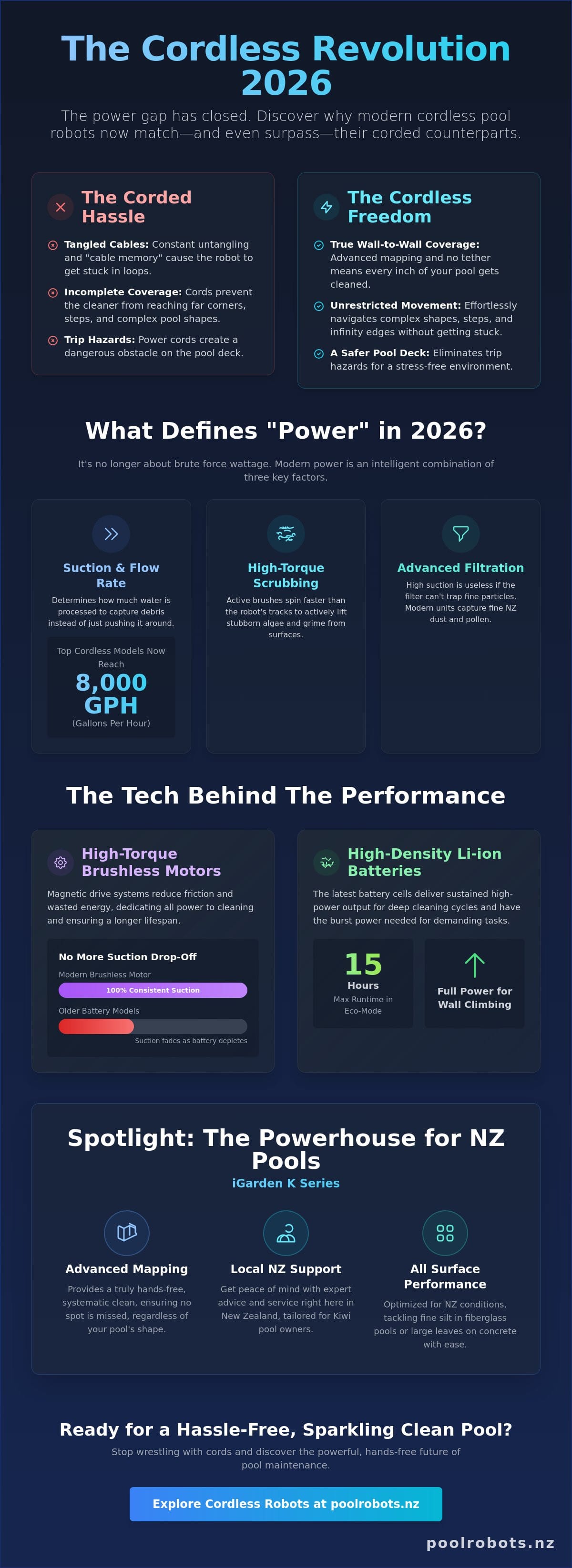
Real power isn't just about motor wattage. It's a combination of flow rate and scrubbing torque. Flow rate, measured in liters per minute, determines how much water the robot can process. If the flow is too low, debris simply gets pushed around. An effective automated pool cleaner also requires high-torque brushes. These brushes must spin at a higher frequency than the drive tracks to lift stubborn algae from the floor. We also focus on filtration micron size. High suction is useless if the filter mesh is too coarse to trap fine New Zealand dust and pollen. Modern units, like the iGarden K Series, use advanced filtration to ensure that what goes in stays in.
Why NZ Pool Owners Are Ditching the Cord
The biggest headache for pool owners has always been "cable memory." This occurs when the power cord retains its coiled shape, causing the robot to get stuck in repetitive loops. It often prevents the cleaner from reaching the far end of the pool or navigating around complex steps. New Zealand's love for unique pool shapes and infinity edges makes cordless units a natural choice. By removing the cord, you eliminate trip hazards on the pool deck and reduce the mechanical strain on the motor. It's a simpler, cleaner way to maintain your pool without the constant need to untangle a plastic mess every Saturday morning.
Suction, Scrubbing, and Flow: Breaking Down 2026 Specs
Many homeowners wonder: are cordless pool cleaners powerful enough to maintain a deep clean throughout the entire battery cycle? In the past, battery-powered robots often lost suction as their charge depleted. That's no longer the case. The 2026 generation of cleaners has moved away from the brute force approach of older, corded models. Instead, they use intelligent power management. By combining high-density lithium-ion batteries with brushless motors, these robots maintain peak performance from the moment they touch the water until they finish the job.
Brushless Motors: The Secret to Constant Torque
The transition to brushless DC motors is a game-changer for cordless efficiency. Unlike traditional motors that rely on carbon brushes, these units use magnets to generate motion. This reduces internal friction and heat. Because there's less energy wasted as heat, more power goes directly to the scrubbing brushes and the vacuum impeller. This tech allows the robot to maintain 100% suction until the very last minute of its cleaning cycle. Recent data from PCMag's 2026 robotic cleaner tests highlights that top-tier cordless models now achieve suction ratings up to 8,000 GPH. This performance easily rivals high-end corded units. Plus, without the physical wear of brushes, these motors typically last much longer than older designs.
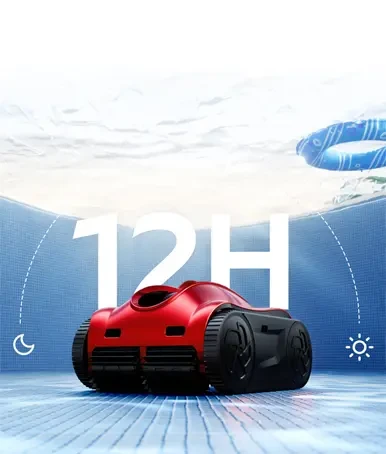
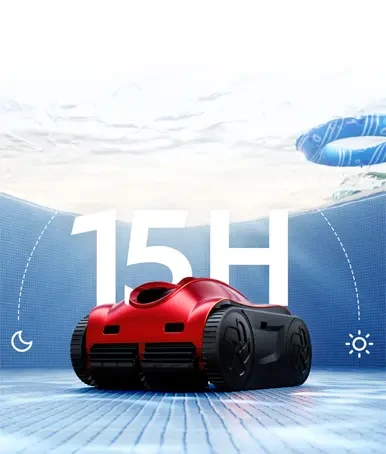
The real breakthrough in 2026 is battery density. Older models from 2023 or 2024 often struggled to finish a large pool on a single charge. Today's high-density cells provide enough energy for high-torque cleaning cycles that can last up to 15 hours in some eco-modes. This isn't just about runtime. It's about having the burst power needed to climb vertical walls and scrub the waterline without slowing down.
Dual-Drive Systems and Wall Climbing
One common complaint on forums is that cordless robots lack the torque to climb walls or they get stuck on floor drains. Modern dual-drive systems solve this by using independent motors for each track. This allows the robot to make 90-degree transitions with ease. When the sensors detect a wall, the robot can shift its weight and increase torque to the drive system. This ensures it doesn't just bump into the wall but actually climbs it to scrub the tiles. Intelligent pathfinding also means the robot maps your pool's unique layout. It chooses the most efficient route rather than wandering aimlessly. This smart cleaning is far more effective than the random, high-wattage suction used by older machines.
Many skeptics still ask: are cordless pool cleaners powerful enough to handle the heavy organic debris found in New Zealand backyards, like large eucalyptus leaves or twigs? The answer lies in the combination of dual-drive torque and wide suction inlets. If you're ready to see this tech in action, you can explore how the iGarden K Series handles complex NZ pool designs with ease.
Cordless vs. Corded: Addressing the 'Power Gap' Myth
The idea that a corded robot is inherently stronger than a battery-powered one is a leftover from the early 2010s. Back then, batteries were heavy and inefficient. Today, the comparison isn't about raw wattage from a wall socket. It's about how effectively that energy is delivered to the water. While corded robots offer infinite runtime, they often spend that time cleaning the same patch of floor because of cable tangles. In contrast, cordless models use targeted, sensor-driven cycles to ensure every square inch is covered. When asking are cordless pool cleaners powerful enough for your backyard, you have to consider the efficiency of the clean, not just how long the machine can stay underwater.
Modern battery management systems have finally killed the "suction drop-off" myth. In older electronics, you might notice a tool slowing down as the battery dies. 2026 pool robots use regulated power delivery. This ensures the motor receives a consistent voltage from the first minute to the last. CNET's comprehensive pool robot tests show that high-end cordless units maintain their rated GPH suction even when the battery hits 5% charge. There's also a significant safety advantage. Running a low-voltage battery unit is much safer than having a 230V power line near a wet pool deck, especially in New Zealand's often unpredictable weather.
The Reality of Battery Life in 2026
Battery technology has reached a point where most residential pools can be cleaned on a single charge. Many modern units feature Eco Modes that optimize power usage for light maintenance, extending runtimes for larger NZ pools. You can expect a high-quality lithium-ion battery to last for over 500 full charging cycles. For the average owner, this means roughly 2 to 3 years of heavy use before a battery replacement is needed. Charging has also evolved. We've moved away from 12-hour overnight waits to fast-charge systems that can have your robot ready to go in just a few hours.
Maintenance Comparison: What Actually Breaks?
When evaluating long-term costs, you have to look at what usually fails. In corded robots, the most common issues are tangled cables, leaking swivel joints, and rusted power pins in the control box. These repairs can be expensive and frustrating. Cordless robots eliminate these physical failure points entirely. Maintenance is simpler, usually involving basic seal checks and monitoring battery health through an app. Fewer moving parts and no external cables lead to higher long-term reliability. If you've been wondering are cordless pool cleaners powerful enough to handle years of NZ conditions, the answer lies in their simplified, robust design that avoids the death by a thousand tangles common in corded units.