How Robotic Pool Cleaners Reduce Chemical Use: An NZ Guide
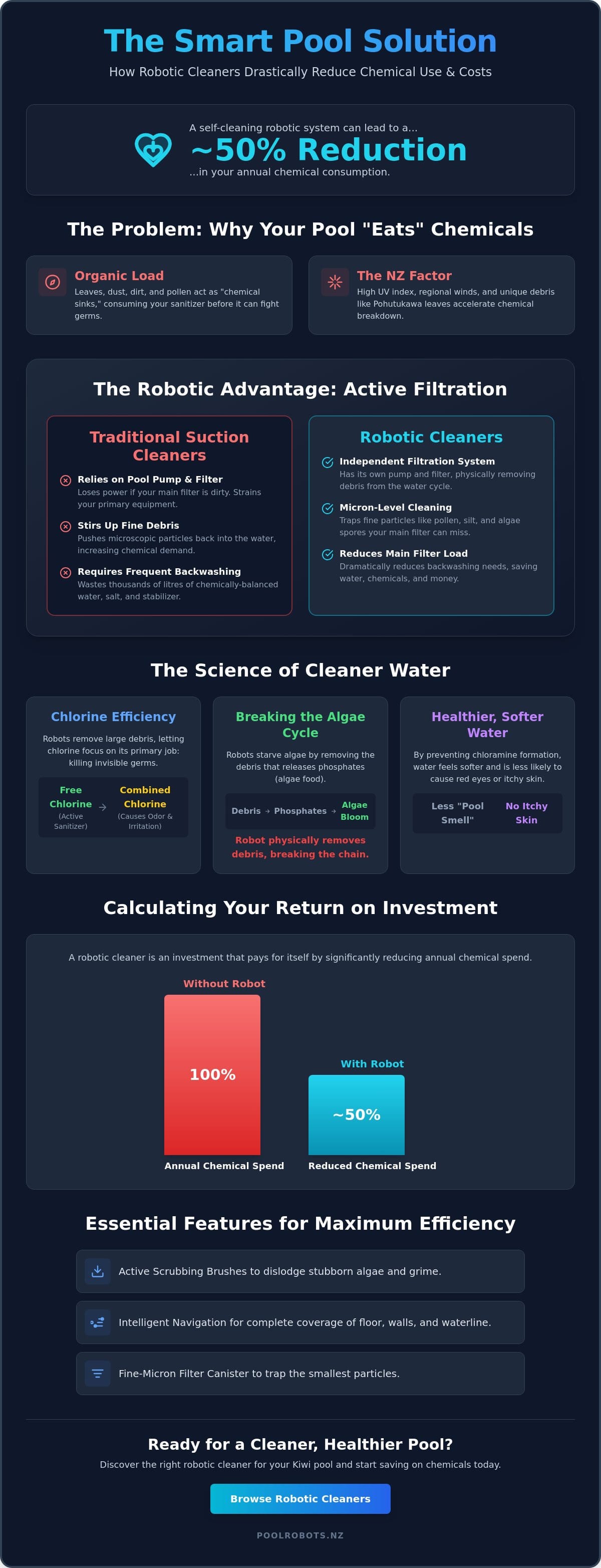
Did you know that a self-cleaning pool system can reduce your chemical consumption by approximately 50%? For many families, the humid Kiwi summer often means a constant struggle against algae and the high cost of sanitizers. Understanding exactly how robotic cleaners reduce chemical use nz is the key to breaking that cycle. These devices do more than just vacuum; they act as a secondary filtration system that keeps your water chemistry in balance naturally.
We agree that your pool should be a place for relaxation, not a source of stress or high maintenance bills. It's frustrating to spend your weekends dosing the water only to be met with strong chlorine odors and irritated skin. This article explores how robotic technology removes organic debris before it can break down and consume your chlorine. You'll discover the science of how these machines stabilize your water chemistry, leading to healthier, natural-feeling water while drastically cutting your annual spend.
Key Takeaways
- Learn why organic debris like Pohutukawa leaves and local dust act as "chemical sinks" that drain your chlorine levels faster than you realize.
- Discover how robotic cleaners reduce chemical use nz by using independent filtration to trap fine particles before they reach your main filter.
- See how New Zealand's high UV index and regional wind patterns contribute to chemical degradation and how automation provides a consistent defense.
- Calculate the potential return on investment by comparing initial costs against the significant reduction in annual chlorine and acid spend.
- Identify the essential features for local pools, such as the active scrubbing brushes and intelligent navigation found in the iGarden K Series.
Table of Contents
- The Science of Sanitizer: Why Your Pool "Eats" Chemicals
- Active Filtration: How Robots Outperform Traditional Suction Systems
- The NZ Factor: Climate, Bio-load, and Chemical Efficiency
- Calculating the ROI: Chemical Savings vs. Initial Investment
- Selecting a Robotic Cleaner for Maximum Chemical Efficiency in NZ
The Science of Sanitizer: Why Your Pool "Eats" Chemicals
Your pool is a living ecosystem that's constantly under attack from the environment. Every time a leaf falls or dust blows into the water, your chlorine goes to work. This biological material is known as "Organic Load." Think of it as the fuel that burns through your chemical budget. In New Zealand, we face unique challenges like oily Pohutukawa leaves or the fine, silty dust common in regions like Canterbury. These items aren't just an eyesore; they act as "chemical sinks." They soak up your sanitizer, leaving very little behind to keep the water safe for your family.
Understanding how robotic cleaners reduce chemical use nz starts with the concept of the "kill rate." Chlorine is highly efficient at neutralizing microscopic bacteria and pathogens. However, when it's forced to break down large, macroscopic debris like a clump of dirt or a decaying insect, it gets exhausted. It spends all its sanitizing power on the big stuff instead of the invisible germs. By removing these large contaminants almost immediately, a robot ensures your chlorine stays focused on its primary job. A cleaner pool requires much less chlorine to maintain a healthy residual because the "food" for bacteria has been removed.
Understanding Total vs Free Available Chlorine
Free Available Chlorine (FAC) is the active portion of your sanitizer that's ready to kill bacteria. Once FAC reacts with organic waste, it becomes Combined Chlorine, also known as chloramines. This is the culprit behind that "pool smell" and the red, itchy eyes often associated with swimming. By using automated pool cleaner technology to pull debris out of the water before it can break down, you stop chloramines from forming in the first place. You'll enjoy water that smells fresh and feels significantly softer on your skin.
The Role of Algae and Phosphates
Algae spores are always present, waiting for the right conditions to bloom. When organic debris is left to rot on your pool floor, it releases phosphates. These are essentially "algae food." Robotic cleaners provide a powerful double defense. They physically scrub the walls and floor, dislodging spores before they can take root. Simultaneously, by removing the waste that produces phosphates, they starve any remaining algae. This simple mechanical action helps you avoid the expensive "algae bloom and shock" cycle that often plagues Kiwi pools during humid summer months.
Active Filtration: How Robots Outperform Traditional Suction Systems
Traditional suction cleaners are often compared to a vacuum that's plugged into your home's main ventilation system. They rely entirely on your pool's primary pump and filter to function. This is known as bypass filtration. If your main filter is even slightly dirty, the suction cleaner loses power. Worse, these older systems often stir up fine debris, pushing it back into the water column rather than trapping it. They essentially move the problem around instead of solving it.
Robotic cleaners operate with a completely different logic. They use independent filtration, meaning they have their own internal pump and filter canister. This autonomy is a major factor in how robotic cleaners reduce chemical use nz. By trapping debris inside the unit itself, the robot ensures that organic matter is physically removed from the water cycle immediately. When water is crystal clear at a microscopic level, your chemicals don't have to work nearly as hard to maintain a sanitary environment. If you want to see the difference this independence makes, you can browse independent robotic filtration systems designed for Kiwi backyards.
Reducing the Load on Your Main Sand or Cartridge Filter
Think of a robotic cleaner as a secondary kidney for your swimming pool. It captures the bulk of the "heavy lifting" before it ever reaches your main filtration system. This drastically reduces the frequency of backwashing for sand filters or manual cleaning for cartridges. In New Zealand, every backwash cycle is a hidden expense. You aren't just losing water; you're flushing away expensive salt, stabilizer, and perfectly balanced chemicals. Keeping that water in the pool means fewer top-ups and less money spent on re-balancing your chemistry from scratch.
Micron-Level Cleaning and Water Stability
Standard suction cleaner baskets are designed to catch large items like leaves or twigs. However, they often miss the fine silt, pollen, and microscopic waste that compromise water clarity. High-quality robots use fine-micron filter canisters that trap particles your main filter might even struggle to catch. This level of precision is vital for maintaining pool water quality and preventing chemical "bounce." When fine particles remain in the water, they can cause pH fluctuations that make it difficult to keep your chlorine effective. In regions like Canterbury, where wind-blown silt is a constant issue, using an ultra-fine filter helps stabilize the water chemistry naturally.
The NZ Factor: Climate, Bio-load, and Chemical Efficiency
New Zealand's environment is undeniably beautiful, but it's remarkably tough on swimming pools. Our high UV levels are the primary driver of chemical loss. Intense sunlight can destroy a significant portion of a pool's chlorine in just a few hours if the water isn't properly protected. Many owners try to counter this by adding heavy doses of Cyanuric Acid, also known as stabilizer. While some stabilizer is necessary, too much leads to "chlorine lock," where your sanitizer becomes chemically bound and unable to kill bacteria. This is a common hurdle in how robotic cleaners reduce chemical use nz. By keeping the pool floor pristine, these machines allow you to maintain a leaner, more effective chemical balance. You rely on physical cleanliness rather than a chemical shield that might eventually stop working.
NZ Environmental Challenges for Pool Owners
Local flora adds a layer of complexity that many international guides overlook. Native trees like the Silver Fern or nearby pine plantations drop fronds and needles that decay rapidly in the water. These materials have a high surface area that traps bacteria and creates a massive "bio-load." In regions like Canterbury, the frequent north-westerly winds dump fine silty dust into pools, which neutralizes chlorine almost instantly. Meanwhile, Auckland's notorious summer humidity creates a perfect breeding ground for algae. A robotic cleaner acts as a constant guardian against these local threats. It removes the organic "fuel" before the humidity or dust can turn your water green. It also helps manage the impact of local rainwater, which can be slightly acidic and throw off your pH balance if organic debris is left to rot at the bottom.
Energy Efficiency Meets Chemical Savings
Integrating a robot into your routine also changes how you run your main filtration equipment. Because the robot handles the heavy filtration and scrubbing independently, you can often reduce the daily run time of your main pool pump. Modern pool energy efficiency standards highlight how localized, low-voltage cleaning is far more effective than running a massive primary pump for twelve hours straight. Shorter pump cycles mean less water agitation at the surface. This naturally leads to lower evaporation rates. Since chemicals evaporate along with the water, keeping the surface still for longer periods preserves your chemical balance. With NZ power prices remaining a concern for many households, switching to a low-voltage robot is a smart way to save on both your utility bill and your monthly chemical spend.