The Best Pool Robots That Clean the Waterline: 2026 NZ Buyer’s Guide
Have you ever spent a sunny Saturday morning on your knees, scrubbing that stubborn grime at the water's edge while your family waits to swim? It's the most exhausting part of pool maintenance, and it's exactly what you hoped to avoid when you bought your first cleaner. Many owners find themselves stuck with a machine that only handles the floor or constantly loses its grip on the walls. You deserve a pristine pool with zero manual effort.
In this guide, you'll discover the technology behind lateral scrubbing and find the perfect pool robot that cleans waterline areas to eliminate manual maintenance for good. We understand the unique needs of local owners and the importance of reliable performance in New Zealand conditions. We will walk you through the top 2026 models, including the innovative iGarden K Series, to ensure your pool remains a place of relaxation rather than a chore.
Key Takeaways
- Understand why the waterline is the most critical area for pool hygiene and how specialized scrubbing prevents stubborn calcium and oil buildup.
- Learn how high-torque motors and advanced sensors allow a pool robot that cleans waterline surfaces to maintain vertical stability without slipping.
- Discover how modern battery technology provides the power needed for intensive wall climbing without the hassle of tangled cords.
- Identify the essential features, such as dual-motor systems and fine micron filtration, that differentiate a basic cleaner from a waterline specialist.
- See why the iGarden K Series is a top choice for New Zealand pool owners looking for reliable, hands-free maintenance.
Table of Contents
- Why Waterline Scrubbing is the Ultimate Test for a Pool Robot
- The Science of Vertical Climbing: How Modern Robots Defy Gravity
- Cordless Freedom vs. Waterline Power: Can You Have Both?
- Key Features to Look for in a Waterline-Focused Cleaner
- Why the iGarden K Series Pro is the NZ Choice for Waterlines
Why Waterline Scrubbing is the Ultimate Test for a Pool Robot
Waterline cleaning is the true measure of a high-quality machine. While many cleaners claim to climb walls, there's a world of difference between a robot that simply touches the tile and one that stays there to work. A true pool robot that cleans waterline areas must overcome gravity and surface tension to scrub the scum line. This is the thin band where water meets the air, and it's where the most stubborn contaminants live. When you invest in a pool robot that cleans waterline surfaces, you're essentially buying back your Saturday mornings.
The history of automated pool cleaners shows us that early designs focused almost entirely on the pool floor. Today, the challenge has shifted to the vertical surface. Most entry-level robots fail here because they lack the sophisticated sensors and motor torque required to maintain their position. They might reach the top, but they quickly lose grip and slide back down. Reaching the waterline is only half the battle; the real value lies in the scrub vs. touch distinction. You don't just want a robot that visits the surface. You want one that stays there to eliminate grime through active friction.
The 'Scum Line' Problem in NZ Pools
In New Zealand, our pools face unique environmental pressures. Our high UV levels are notorious for baking sunscreen and body oils onto the pool surface. This creates a sticky residue that acts like a magnet for wind-blown dust and native pollen. If left alone, this mixture hardens into a tough, unsightly ring. Manual scrubbing is often the number one chore Kiwi pool owners want to outsource. It's back-breaking work that takes away from your leisure time. A reliable robot handles this task daily, preventing the buildup from ever becoming a permanent stain.
Waterline Mode vs. Standard Wall Climbing
It's helpful to understand how different robots handle vertical surfaces. Standard wall climbing is usually a simple up-and-back motion. The robot hits the waterline, senses the change in pressure, and immediately reverses. This does very little for actual cleanliness. In contrast, a dedicated waterline mode allows the robot to move laterally. It travels sideways along the surface, using active scrubbing brushes to physically remove deposits. While passive movement relies on the robot's weight to drift, active scrubbing uses dedicated motors to provide the force needed for a deep clean. This lateral stability is what keeps your pool looking pristine without you ever picking up a manual brush.
The Science of Vertical Climbing: How Modern Robots Defy Gravity
Understanding how a pool robot that cleans waterline areas actually works requires a look at physics. It isn't just about the machine driving up a surface. It involves a delicate balance of buoyancy, weight distribution, and suction power. High-torque brushless motors are the heart of this process. They generate the necessary thrust to keep the unit pinned against the vertical tile. These motors are more efficient than traditional ones, providing the sustained power needed to fight gravity without overheating.
Modern designs rely on the scientific principles of wall-climbing robots, specifically using negative pressure suction. This creates a vacuum effect between the robot and the pool wall. For a robot to be effective, its chassis must have perfect weight distribution. If it's too top-heavy, it will tip away from the wall. If it's too bottom-heavy, it won't have the leverage to scrub the waterline effectively. Dual-scrubbing brushes add the final touch by providing intense friction. This friction is vital because the waterline is often slippery with algae or calcium deposits.
Propulsion and Suction Mechanics
The secret to staying stuck is often the Venturi effect. By rapidly pumping water through the center of the unit, the robot creates a low-pressure zone that sucks it toward the surface. One of the biggest challenges is preventing air intake. If the pump sucks in air while the robot is at the surface, it loses suction and falls. Engineers use sophisticated baffles to keep the water flowing correctly. In New Zealand, many pools use smooth ceramic tiles. This makes tracks superior to wheels, as they provide a larger surface area for grip.
Intelligent Navigation Systems
To ensure every centimetre of the pool is reached, these machines use advanced gyroscopes and accelerometers. These sensors tell the robot's "brain" exactly what angle it's at. This prevents the unit from flipping over or getting stuck in a corner. Intelligent mapping software tracks the perimeter to ensure no spots are missed. Lateral waterline movement is the specific ability of a robot to drive sideways along the tile line to ensure a deep, consistent clean. This horizontal travel is what separates a true waterline specialist from a standard wall climber.
Finding a machine with this level of engineering makes maintenance much simpler. If you're looking for a reliable pool robot that cleans waterline areas, exploring the latest K Series models is a great place to start.
Cordless Freedom vs. Waterline Power: Can You Have Both?
Many pool owners worry that choosing a battery-powered unit means sacrificing performance. In years past, this concern was valid. Older batteries were heavy and lacked the sustained output needed to fight gravity for long periods. However, the 2026 reality is quite different. Modern high-density lithium-ion batteries and lightweight carbon-fibre composites have solved the weight-to-power ratio. A cordless pool robot that cleans waterline areas now has the stamina to stay pinned to the tile for a full cleaning cycle without slipping.
Removing the cord actually provides a significant mechanical advantage. Traditional robots often suffer from "cable memory," where the power cord becomes stiff and coiled over time. These tangles don't just look messy; they act as a physical anchor. When a corded robot tries to reach the top of the wall, a tangled cable can literally pull it back down or flip it over. Cordless models enjoy total freedom of movement. They can navigate complex paths and lateral scrubbing patterns without any external resistance or drag.
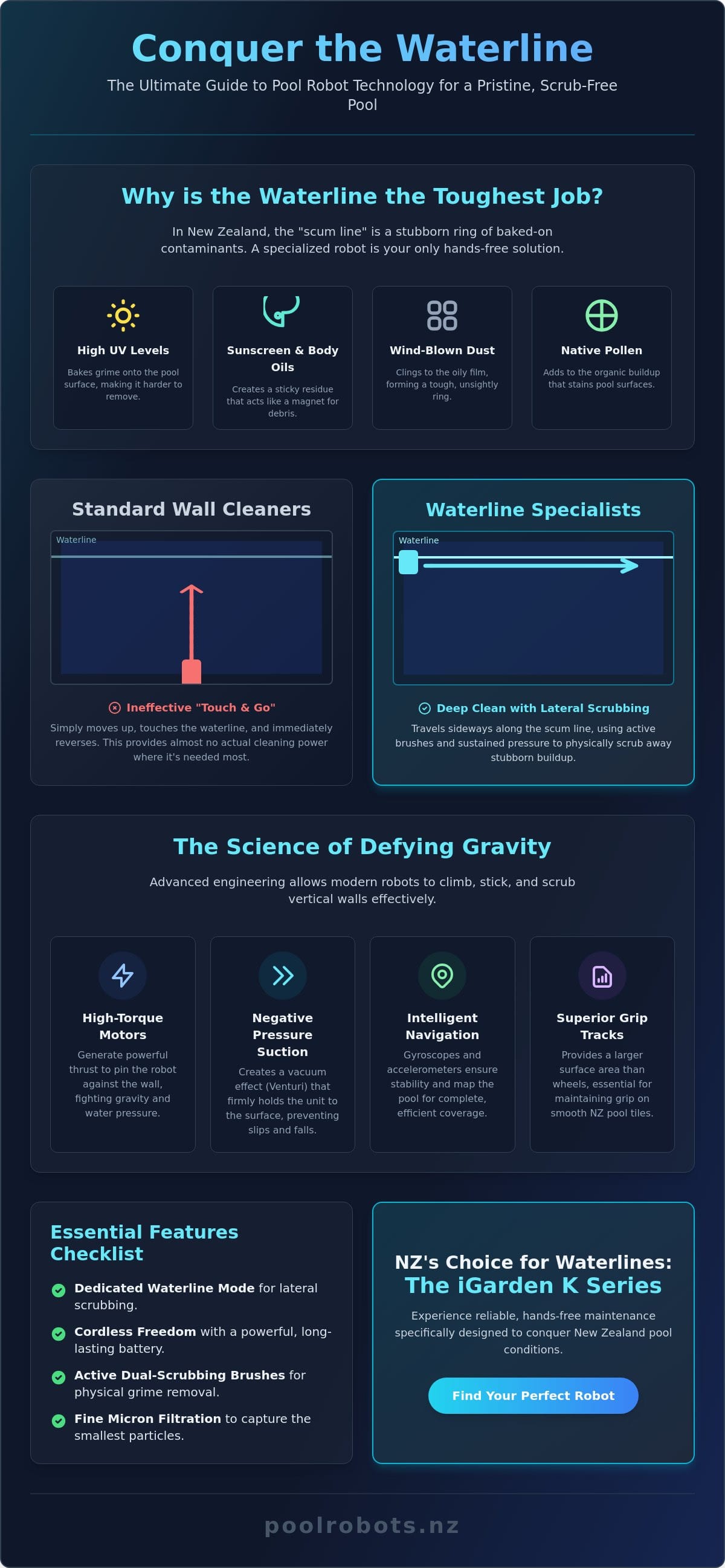
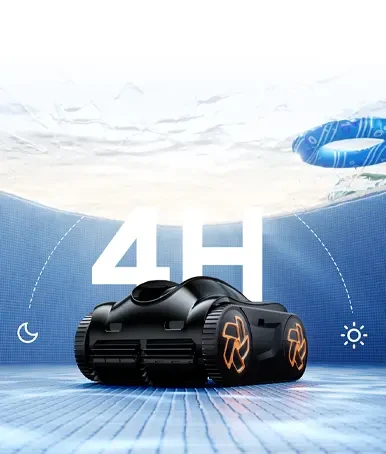
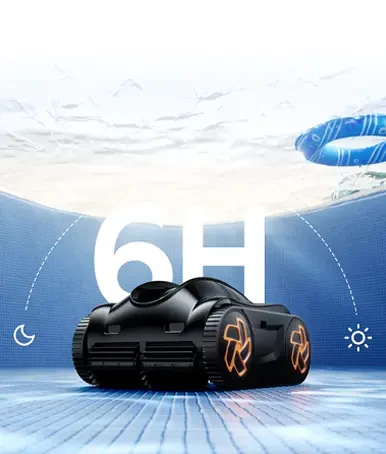
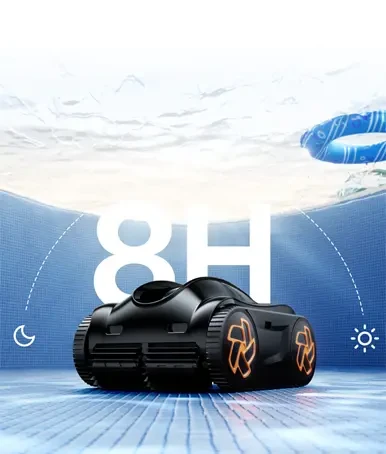
Run-times are an important consideration when comparing these technologies. Waterline scrubbing is energy-intensive. Intensive cleaning requires the pump motor to work at maximum capacity to maintain suction while the drive motors move the unit sideways. While a floor-only cycle might last several hours, a comprehensive wall-and-waterline cycle is more demanding. If you want a pool robot that cleans waterline surfaces without the hassle of a power lead, the 2026 generation of robots offers a perfect, high-performance solution.
The Gravity Challenge for Cordless Robots
The iGarden K Series Pro is a great example of how modern engineering tackles vertical surfaces. This model is designed for neutral buoyancy. The internal components and battery pack are positioned to ensure the robot doesn't feel heavy in the water. This balance allows it to move effortlessly from the floor to the waterline. Without a cord to drag, it can follow the entire perimeter of your pool without interruption. The trade-off is often a slightly shorter run-time in "intensive" mode, but the trade is well worth it for a truly hands-free experience.
Reliability in the NZ Sun
New Zealand's harsh UV levels take a toll on pool equipment. Cords left in the sun often become brittle, crack, and eventually fail, leading to expensive repairs. By choosing a cordless system, you eliminate a major point of mechanical failure. There's also a significant safety benefit. Removing 240V cables from the pool area provides peace of mind, especially for families with young children. For a deeper look at this comparison, read our guide on Cordless vs Corded Pool Robots: Which is Best?.